Hold the Send
Is it safe for car salespeople to paste customer chats into ChatGPT?
Pasting a customer chat into an AI service shares that text with the service. Use only a tool and account your dealership has approved for that data. Remove unnecessary personal and financial details, check the plan's data controls, and review what remains. Masking reduces exposure but does not make a message anonymous.
Before using a live conversation, ask your store which information is necessary for the draft and which channel is approved for sharing it.
By Nathan Platter. Updated . Sources and product limits are linked below. Check current requirements for your store and channel.
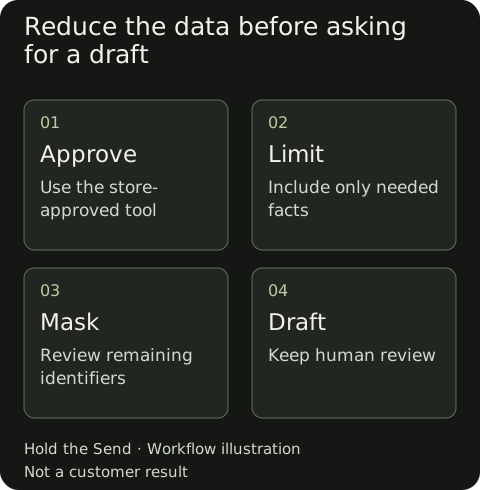
What does masking remove from a customer message?
Masking hides selected details, but it can leave identifying information behind. We ran a made-up customer message through the same mask the Hold the Send desk uses before it asks the AI for a draft. Before:
Hi, it's Sarah Miller, call 402-555-0147, sarah.m@example.com, I'm at 1234 Maple St.
After, which is what the AI sees:
Hi, it's Sarah Miller, call •••-•••-0147, s•••@example.com, I'm at ••••.
Two things to notice. The street address is gone. The phone number and email are hidden, but the last four digits and the email domain stay. And the name stays as written. Masking lowers what leaves the store. It does not make a message anonymous.
What customer information can a pasted chat contain?
- The customer's name and phone number, usually in the same paste.
- An email address, a street address, sometimes a work or family detail the customer mentioned.
- A trade-in with its VIN, miles and payoff.
- A hint about credit, a payment they want, a down payment they have.
- The rep's own notes about the deal.
Each of those is easy to paste and hard to take back.
What should a dealership policy say about AI drafting?
- Name the one AI tool reps may use for customer messages, and the plan the store pays for.
- Never paste a Social Security number, a date of birth, an account or loan number, or a credit score.
- Keep interest rates, payments and credit scores out of written messages altogether. Move that conversation to a call or the store.
- Mask phone numbers, emails and street addresses before anything is pasted into a tool, or use a tool that does it for the rep.
- Once the rep sends, the message goes into the store's own communication history. Keep it there, not in a chat tool's history.
- Review the policy every quarter, because tool terms change.
What should a store check before approving an AI tool?
What happens to pasted text depends on the tool, its plan and its settings. Ask, and get the answer in writing:
- Is pasted text used to train the tool?
- How long is it kept, and can the store delete it?
- Who at the vendor can see it?
- Does the store have a signed agreement, or only click-through terms?
- Is the rep on a store account or a personal one?
We have not listed any vendor's answers here, because they change and they differ by plan. Read the vendor's own current terms for the exact plan a rep uses.
What does Hold the Send mask, and where?
The desk masks phone numbers, emails, Social Security numbers, labeled dates of birth, labeled account, loan and policy numbers, and street addresses. Names stay as written.
- The server runs the mask on the message before it asks the AI for a draft.
- The same mask runs when a thread is saved on the device.
- The activity log records drafted, flagged, copied and marked-sent, with no message text. It lives in the rep's browser and is capped at 400 rows. The server keeps usage counts only.
- Once the rep sends, the message belongs to the store's own communication history. That is your system, not ours.
We do not claim to mask everything. Credit scores and protected-class details are not on the masked list, which is one more reason they stay out of written messages in the first place. The hold list is the first line of defense and masking is the second.
Who remains responsible when a vendor processes customer data?
The FTC's Safeguards Rule guidance says a service provider is anyone who gets, keeps, processes or can access customer information while providing services to a covered company. It says to choose providers with the skills to keep it safe, spell out expectations in the contract, and keep checking, and that the buck still stops with you. The page does not name car dealers, so ask your counsel whether and how the rule applies to your store.
Where Hold the Send fits
Hold the Send, the AI Messenger copilot for car dealership reps, drafts the reply from the facts your rep pastes about the vehicle and the store's rules. Your rep reads it, edits it and presses Send. Nothing goes out on its own.
The same desk works on text, Instagram DMs and Facebook Messenger. We name the channels we have run, so ask about the one you use.
What does masking not guarantee?
- We do not have a SOC 2 report and have not started an audit.
- There is no outside penetration test yet.
- A data retention schedule is not published yet. Ask us and we will tell you what is kept and for how long today.
- There is no single sign-on. Reps sign in with invite codes.
- Masking reduces what the AI sees. It does not replace a vendor agreement or your store's own privacy obligations.
Full limits are on the trust page and the compare page.
See it on your own leads
Book 15 minutes with Nathan. You see which of last week's leads waited more than an hour, and the draft your rep could have sent on each. Your rep still presses Send.
Sources
FTC, Safeguards Rule: What Your Business Needs to Know, linked above. Masking and storage facts from the trust and compare pages, and the masked example run through the desk's own mask on November 3, 2026.