Hold the Send
AI copilot or AI chatbot for dealership reps: who presses Send?
An AI copilot prepares a draft for a person to review and send; an automated chatbot can send configured replies itself. Product names do not guarantee either behavior. For a dealership, check who can approve prices, how uncertain answers are handled, and which messages require human review before choosing a workflow.
Chatbots fit high-volume after-hours questions with low risk. A copilot fits personal follow-up, where the rep's name is on the deal and a wrong number costs money.
By Nathan Platter. Updated . Sources and product limits are linked below. Check current requirements for your store and channel.
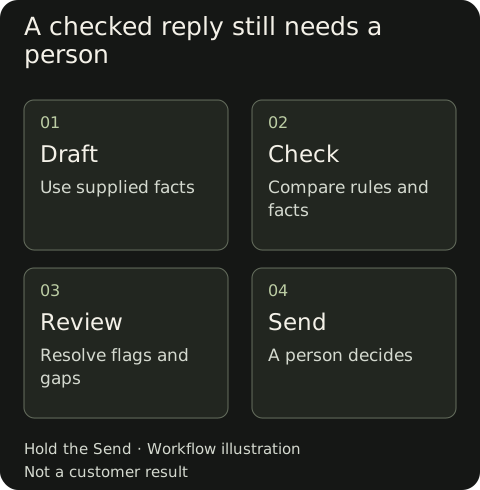
How do a copilot and an automated chatbot differ?
The difference between an AI copilot and an automated chatbot is who approves and sends each reply. The comparison below covers automated sending and a workflow where a person reviews each draft.
| Automated chatbot | AI copilot | |
|---|---|---|
| Who sends | The software, on its own. | The rep, after reading the draft. |
| Who is accountable | The store, for words no person read. | The store, for words a named person approved. |
| Best use | Fast first answers at any hour, and simple questions with a fixed answer. | Personal follow-up, price pushback, trade-ins and getting the customer to show up. |
| Main risk | A promise about price, payment or availability that nobody checked. | A draft that waits until a rep is free to send it. |
Does an angry message mean a buyer is not interested?
An angry message can still come from a buyer who is ready to purchase. Dealership reps should check the customer’s request as well as the tone. In the Hold the Send demo a buyer writes, "Honestly the price is too high. $2,500 off and I'm there today." The tone is negative. The intent is to buy today.
LotBeacon’s demo reply avoids quoting a new price. The sample reply flags the request for a manager, says the manager will review it before the customer drives in, and holds a 4:30 visit. A dealership rep should review both the price request and the proposed visit before sending. Read the related guide on who is on the hook for a chatbot's price promise.
How does Hold the Send handle a reply?
Hold the Send, the AI Messenger copilot for car dealership reps, works like this:
- Prioritize. The queue is sorted by buying intent. That is in the demo and rolling out on the live desk.
- Draft. The reply is written from the facts the rep pasted, and each fact shows where it came from.
- Check. A made-up discount, payment, hold, sold unit or off-hours promise is flagged.
- Hold the send. The rep reviews, edits and sends. Nothing goes out on its own.
LotBeacon’s dealership workflow aims to prepare a useful reply before the customer’s visit. The rep still needs to resolve questions about price, a trade-in, or another decision-maker.
When might an automated chatbot fit?
- You get leads at night and on weekends and nobody can answer for hours.
- The questions are simple and the answers are fixed: hours, directions, whether a unit is on the lot.
- You have a person watching the handoff, and rules that stop it from quoting price, payment or trade value.
Automated dealership replies can suit fixed answers about opening hours or directions. Ask each vendor how its tool hands a conversation to a person and restricts answers about money.
When might a copilot fit?
- The rep's name is on the deal and the customer expects to hear from that rep.
- Price, payment and trade questions come up in writing and a manager needs to see them.
- The store wants every sent message to have a named person behind it.
- Reps are fast to type but slow to follow up, and a ready draft fixes the second part.
The reasons behind the human-sends rule are on three other pages: price promises, pasting customer chats into AI tools, and Messenger's 24-hour window.
Which tools does a copilot work beside?
Hold the Send is not a CRM. It sits next to the system your store already uses. Here is how a few of those systems describe themselves on their own sites:
- VinSolutions: an AI-powered CRM for auto dealerships.
- DriveCentric: an AI-powered CRM for car dealerships, with an AI assistant and built-in texting.
- AutoRaptor: a web-based CRM platform, with an AI assistant that replies to inbound leads.
- Dealer Funnel: an AI-driven platform that replies to incoming leads, with text, voice, chat and email in one inbox.
- DealerCRM: a dealership operating system that combines CRM, phone, texting, email, desking and inventory.
Some dealership CRM vendors also describe automated AI follow-up. A dealership evaluating automation should identify which messages require a person’s review before sending. For a side-by-side with one full-auto tool and a category table, see the compare page.
How can a dealership evaluate a pilot in one week?
- Pick one rep and one week.
- Measure three things: time from paste to sent, replies per lead, and how many drafts the rep edited before sending.
- Review the flagged messages with the manager on Friday.
- Decide whether the draft saved time or only added a step.
Hold the Send offers a 15-minute review using the store’s leads from the previous week. The review identifies leads that waited more than an hour and shows a possible draft for each.
What does LotBeacon cost?
LotBeacon list prices are Solo $149 · Independent Lot $299 · Franchise Store $599 a month. LotBeacon founding rates are Solo $74 · Independent Lot $149 · Franchise Store $299, locked 12 months, first 20 licenses. Current prices are on the pricing page.
What does Hold the Send not promise?
- Hold the Send is not a CRM and not a replacement for a BDC.
- The demo does not send through live Meta today.
- Voice is talking points only. The rep dials.
- ROI is modeled. We have no case studies yet.
- There is no 24-7 chat. Drafts wait for a rep.
- We do not have a SOC 2 report and there is no outside penetration test yet.
- Hold the Send is not approved or certified by any automaker.
Full limits are on the trust page and the compare page.
See it on your own leads
Book 15 minutes with Nathan. Your rep still presses Send.
Sources
The NIST AI Risk Management Framework calls for defined roles and responsibilities for human oversight. Use that as a question for vendors: who reviews an uncertain answer, and who can stop it?
The FTC's automobile pricing FAQs cover truthful pricing in dealer communications, including texts. A product's automation label does not settle whether a particular message is accurate or appropriate.
Tool descriptions are from each vendor's own home page, read November 3, 2026. Product limits and prices from the compare, trust and pricing pages.